Keyword Clustering: How to Group Keywords Into Pages That Rank
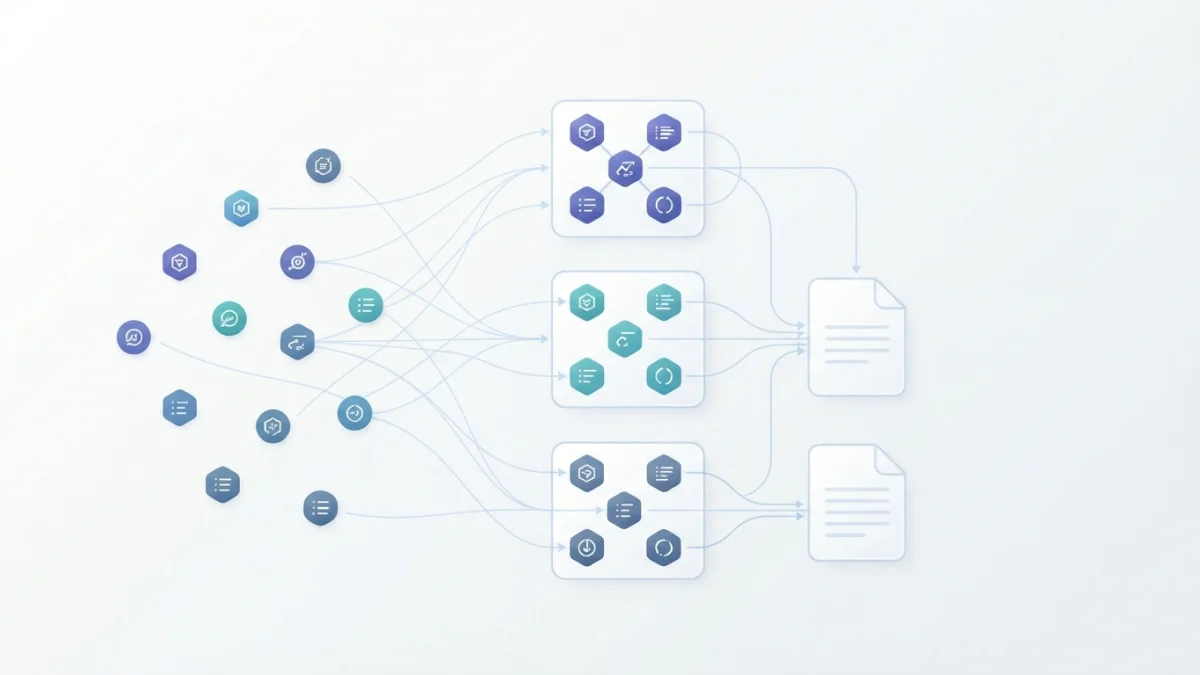
Table of contents
Do a hundred keywords mean a hundred pages? No: many share the same intent and Google already treats them as a group. Keyword clustering tells you which ones to target together - and which not - before you write a single word.
After keyword research it is normal to end up with a list of hundreds of terms: variations of the same idea, questions, synonyms, different formats of the same search. The classic mistake is turning that list into a publishing calendar with one page per keyword. The result is usually dozens of thin pages competing with each other, and none of them ranking.
This article explains what keyword clustering is, why grouping keywords by search intent and similar SERPs pays off, and how to run the method step by step with data you already have in Search Console.
What keyword clustering is (and isn't)
Keyword clustering is the practice of grouping keywords with the same or very similar intent so you can target them with a single page instead of creating one URL per variation. The most cited definition comes from Ahrefs: find the keywords Google already considers equivalent and give them one solid answer.
It is worth clarifying what it is not, because a lot of hype surrounds the term:
- It is not an official ranking factor. Google has no signal called "keyword clustering". It is a planning practice that takes advantage of how the search engine really works.
- It is not a trick to rank for 50 keywords for free. There is no magic percentage or secret formula: clustering helps you build better pages, not game the algorithm.
- It is not the same as a topic cluster. Clustering groups keywords; topic clusters organize content around a pillar topic. They complement each other: first you cluster the keywords, then you build your topical authority architecture with the pages you decide to create.
What is the real foundation in Google? The official documentation on consolidating duplicate URLs explains that when URLs are similar, Google clusters them and picks the most complete and useful page as the canonical one. If you give it one robust page per group, you make that choice easier and prevent it from picking a weak variant.
Why cluster: the real cost of "one page per variation"
Creating one page per keyword sounds logical, but it has three costs that show up in your results:
Cannibalization between pages of the same cluster
Two of your own pages competing for the same group of queries steal clicks from each other and split the authority they could concentrate. Google ends up choosing one of the two - not always the one you prefer - and the other becomes dead weight. If you have not suffered this problem yet, learn how to detect keyword cannibalization before it grows.
The practical limit of results per SERP
The same domain rarely occupies more than two visible results for a query. Creating five URLs for the same intent does not add visibility: you are splitting your chances among five pages that cannibalize each other. One strong page has a better shot at that spot than five mediocre variants.
Editorial efficiency
Writing ten thin pages costs more time and money than writing two or three deep pages that truly answer the topic. Clustering also improves maintenance: updating one canonical page is easier than keeping ten URLs alive, all of them candidates for going stale.
In 2026 the angle also changed with conversational search: AI Overviews and assistants cite pages that answer the full topic, not scattered fragments. One robust page per intent is far more citable than ten thin fragments, and that same solidity is the foundation of entity SEO when Google tries to figure out what your brand is about.
The rule that matters: intent and similar SERPs
When should two keywords live on the same page? The practical rule is simple: if Google ranks the same pages for two keywords, they share intent. You can check it "by eye" by comparing the results of both searches: if you see the same domains and the same URLs in similar positions, Google almost certainly treats them as the same query.
This manual method - sometimes called the eyeball method - is free and good enough for most projects. You do not need to pay for a tool to start: open two searches in an incognito window, compare the results, and decide.
Keyword modifiers are initial clues about intent, never absolute truth: "how", "best", "price", "buy", "cheap" or "for X" point to different intents, but the SERP decides. The exception to the rule matters too: if the SERPs look different or the intent differs (a transactional query for a specific brand versus a general informational one), you need separate pages. A poorly built cluster mixes intents and ends up as a page that satisfies nobody.
How to do keyword clustering step by step
The complete method combines what you already know from keyword research with a SERP validation and the real data from your Search Console. These are the five steps:
Step 1: gather the list
Start from all your keyword sources: the initial research where you chose your main keywords, Google Trends to measure seasonality and discover variants, and above all the real queries already bringing you impressions from Search Console. The list should include variations people actually searched, not invented combinations.
Step 2: group by broad intent and SERPs
First make a rough pass by intent: informational, transactional, navigational and local. Then, inside each group, compare the Google results of the candidate terms. Those sharing similar SERPs stay together; those that do not get separated. This second filter is what stops you from grouping by superficial word similarity instead of real intent.
Step 3: pick the cluster's head keyword
Every cluster needs a head keyword: the one with the highest volume or the best fit for your page. That keyword becomes the focus of the title, the introduction and at least one heading. The rest enter as natural variations within the text. John Mueller has said it several times: you do not need to mention every possible variation of a keyword on a page for Google to understand it.
Step 4: validate with real Search Console data
If two queries are already sending clicks to the same URL, they are already part of the same cluster in practice: Google is telling you that page answers both. Instead of creating a new page, optimize the existing one to cover the whole group better. It is the strongest signal you can use, because it comes from your own real behavior in the search results.
Step 5: consolidate what already exists
If two of your own pages already rank for the same group, do not create a third: merge the content and redirect with a 301 the loser, or apply content pruning if one of them is weak. Tools that automate clustering (Ahrefs Keywords Explorer, Semrush, Keyword Insights) save you the manual work at scale, but the SERP plus Search Console method works just as well for medium projects without paying extra.
Common mistakes
Keyword clustering looks simple, but you can get it wrong in several ways:
- Creating one page per keyword variation. This is the mistake clustering prevents: you end up with dozens of URLs competing with each other.
- Mixing intents to "save" pages. Combining an informational query with a transactional one produces a page that answers neither well.
- Stuffing the page with every forced variation. You do not need to mention them all. Variations come naturally when you write well; SEO copywriting shows you how to do it without forcing them.
- Clusters so broad that the page becomes generic. If SERP validation shows the group splitting into different intents, divide the cluster into two pages.
Checklist for your next content plan
Before you turn your keyword list into an editorial calendar, review this checklist:
- Keyword list gathered from every source (research, Trends, Search Console).
- Rough grouping by intent: informational, transactional, navigational, local.
- Similar-SERP check inside every group.
- Head keyword chosen for each cluster.
- Search Console validation: queries already clicking to the same URL.
- Decision per cluster: create a new page or consolidate what exists with a 301.
- Keyword in the title, the introduction and at least one heading, with variations integrated naturally.
- Content without emojis, with a featured image of at least 1200 px and nofollow attributes on external links.
Keyword clustering will not change your rankings overnight, but it changes the quality of your decisions: fewer pages, better pages, and every URL with a clear purpose Google can understand. That is the foundation everything else builds on: content architecture, topical authority and, eventually, sustainable organic traffic.