SEO Copywriting: How to Write an Article That Ranks on Google
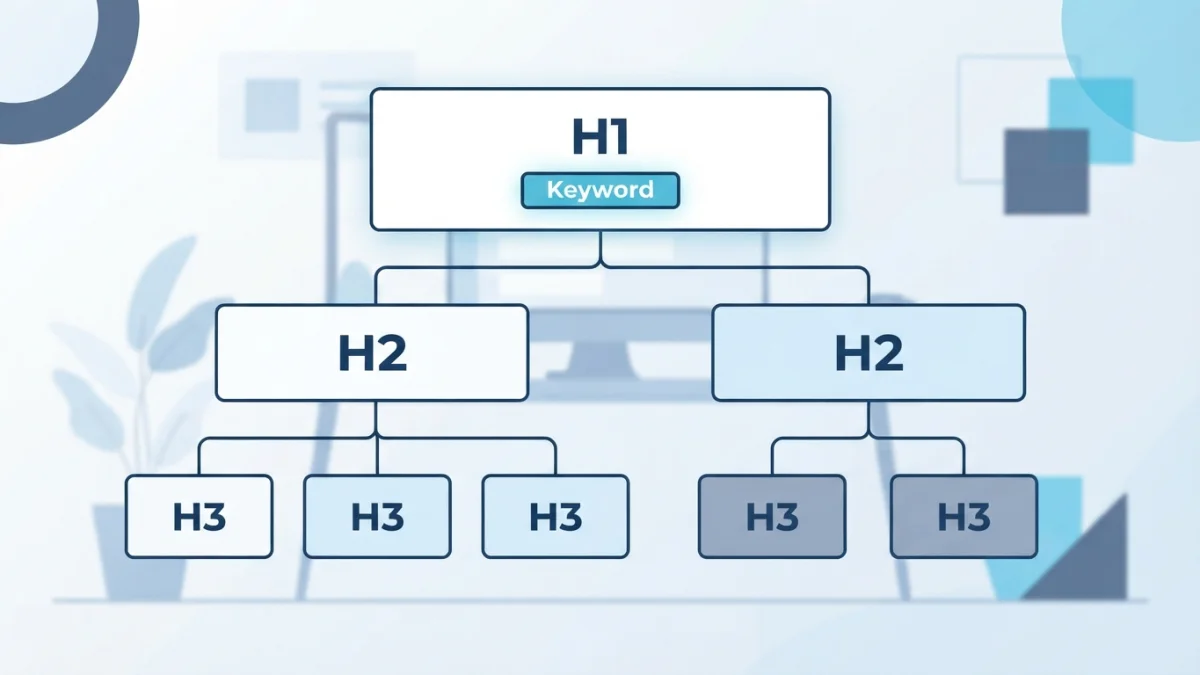
Table of contents
A post that doesn't rank is rarely a "content volume" problem: it's a structure problem. This SEO copywriting guide shows you how to write and organize an article that Google understands, readers actually finish, and AI answer engines cite.
What SEO copywriting is (and isn't)
SEO copywriting is the practice of writing content that is genuinely useful to people while giving search engines clear signals about what the page covers. It is not a writing trick or a secret formula: it is applying clarity, hierarchy and relevance to every piece of text you publish.
It helps to start with what it is NOT. It is not padding paragraphs with synonyms of your keyword. It is not chasing a magic keyword density percentage. It is not stretching a topic to hit a minimum word count because "long articles rank better." Those three habits come from old myths, and they usually produce content nobody finishes reading and Google does not reward either.
Google's own guidance on creating helpful content makes one point over and over: a page is evaluated by how useful it is to the searcher, not by its length. A short, direct answer can outrank a long article padded with filler.
The problem is not that writers ignore these practices. A Content Marketing Institute survey published in May 2026 found that 71% of marketers say they know SEO copywriting practices, but only 26% achieve consistent results (SEO Copywriting in 2026). The gap is in execution: knowing what SEO copywriting is and applying it well to every single article are two different things.
Before you write: one page, one search intent
The first writing mistake happens before you type a single line: publishing one page that tries to answer several questions at once. Every article should target one main keyword and one concrete search intent, informational or transactional. If someone searches "how to run an SEO audit", a page mixing the definition, the history of SEO and a pitch for your services will not satisfy them.
Before drafting, look at what currently appears on the first page of results for that query. Not to copy the exact format, but to understand what kind of answer satisfies the user: a step-by-step guide, a comparison, a list of tools. Paraphrase and improve what you see; never paste content from your competitors.
The title: an honest promise
The page's <title> and its main heading (H1) do the same job: tell the reader and Google which question you are about to answer. A good SEO copywriting title is descriptive and specific. "How to Write an SEO Article in 7 Steps" promises a concrete process; "Everything About SEO" promises nothing.
Avoid clickbait. Misleading titles earn clicks in the short term, but they inflate bounce rate and, for years now, Google has demoted pages that do not deliver on their title's promise. If you want to go deeper into writing title tags that earn clicks without getting rewritten, read our guide to SEO titles.
Article structure: a scannable hierarchy
Most readers do not read an article top to bottom: they scan it. H2 and H3 headings are the skeleton that makes scanning possible, and search engines use them to understand the document's structure. A well-structured article shows three layers at first glance.
Lead with the answer
Answer the essential question in the first lines, then expand. If your article explains how to configure robots.txt, the introduction should summarize what it is and when you need to touch it, not tell the story of how you discovered SEO. This "bottom line up front" technique helps hurried readers and the search engines that extract featured snippets.
One H2 per idea, H3 for detail
Each H2 represents one complete idea; H3s develop nuances inside that idea. Do not skip levels: jumping from an H2 to an H4 without an H3 in between confuses readers and the systems that generate the table of contents. Since the site's index is built from heading ids, every H2 and H3 should make sense on its own, outside the article's context.
Lists, steps and examples
Processes are written as numbered steps and comparisons as bullet points. Include real examples whenever you can: one concrete example of a weak headline and its improved version teaches more than three paragraphs of theory. If you borrow ideas from a source, paraphrase them and cite the origin with a link; copied content builds no authority and risks a penalty.
Keyword placement (and where not to force it)
Your main keyword has natural places where it adds signal: the title, the first paragraph, at least one H2 and, if possible, the anchor text of your first internal link. Outside those positions, write naturally: synonyms and long-tail variants usually reflect how real users search better than repeating the exact same phrase.
This is where one of the most persistent SEO copywriting myths appears: the ideal keyword density. There is no target percentage that Google rewards. Hobo-web sums it up with a simple question: does a text with the keyword at 2% outrank one at 1.8%? Of course not. Search Engine Journal documents the same conclusion: keyword density is not a confirmed ranking factor. What matters is that the keyword appears where it makes sense and the rest of the text sounds human. If you notice the repetition while rereading a paragraph, you are forcing it and should rewrite it.
Writing for humans... and AI answer engines
In 2026, ranking is no longer only about appearing in the blue list of results. Google's AI Overviews and assistants such as ChatGPT, Gemini or Perplexity cite pages when they need a trustworthy answer, and they choose text with clear structure and self-contained context. This does not change the rules of SEO copywriting: it reinforces them.
A page that answers a concrete question in a complete paragraph, with descriptive headings and sourced data, is easy to cite. Current guides from SEO tools reach the same conclusion: articles should be written so a system can extract an answer without reading the whole page (12 SEO writing tips). Structured data helps the engine understand the content type, but it does not compensate for confusing prose: clear writing is still the foundation.
Final pre-publish checklist
Before you hit publish, run through this list. If one point fails, the article is not ready:
- One search intent per page, confirmed against the current SERP.
- Honest, specific title with no promises the content does not keep.
- Introduction of one to three sentences that answer the essential question.
- H2 and H3 hierarchy with no skipped levels and descriptive ids.
- Main keyword present in the title, the introduction and at least one H2.
- 800 to 1,500 words with no filler: every paragraph adds something new.
- Internal links to related articles and external links with
rel="nofollow noopener noreferrer"andtarget="_blank". - Featured image at least 1200 pixels wide with descriptive alt text.
- No emojis in the body HTML and no stray characters that break reading.
SEO copywriting is not a skill you master by reading one article: you master it by publishing, measuring and correcting. Apply this structure to your next post, compare the behavior in Search Console after a few weeks, and adjust what does not work. That write-and-measure loop is worth more than any writing template.