Topical Authority: What It Is and How to Build It for Google (and AI Search)
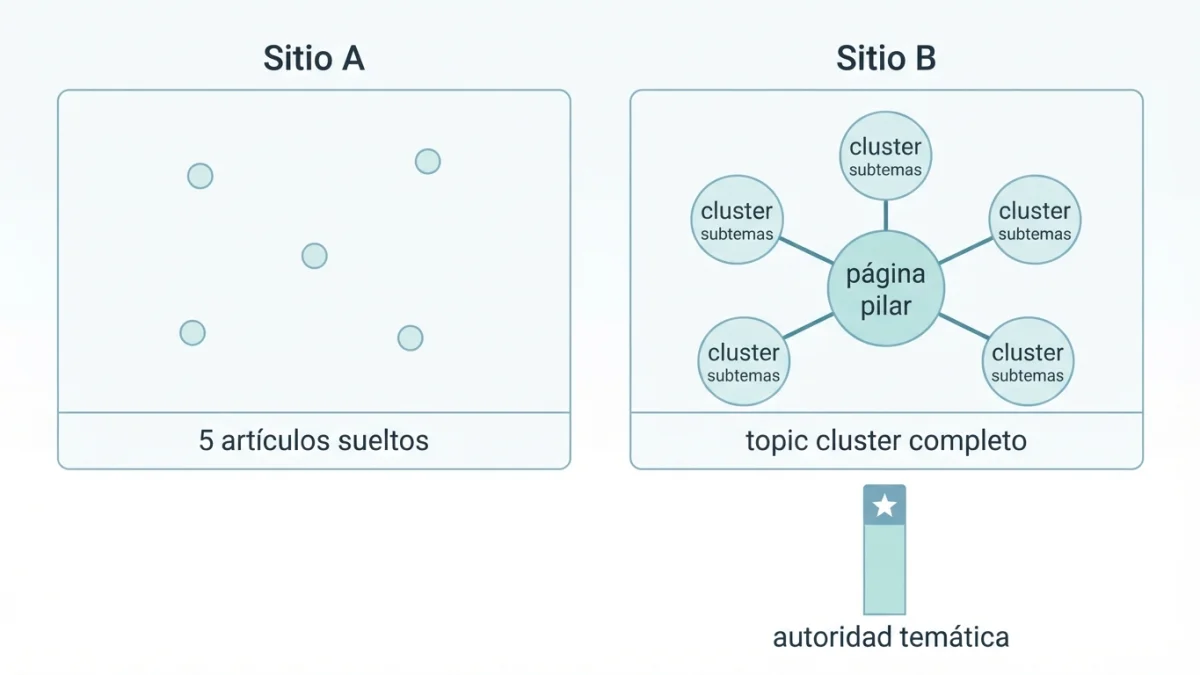
Table of contents
What Topical Authority Is (and What It Isn't)
Topical authority is the perception Google and AI search engines have that your site owns a complete topic, not a single keyword. It is built with coherent content, topic clusters, and consistency. Here is the 6-step method, with data.
The Difference From Domain Authority
Domain authority measures the strength of your backlinks (DR, DA) and is calculated by third-party tools. Topical authority, on the other hand, is perceived expertise by topic: a site with few links can have more topical authority than a giant in a specific niche, simply because it covers that topic better than anyone else.
How It Relates to E-E-A-T
E-E-A-T (Experience, Expertise, Authoritativeness, Trustworthiness) is the general quality framework Google applies to your site. Topical authority is the concrete content strategy: while E-E-A-T evaluates who you are and how much trust you inspire, topical authority describes how well you cover a complete topic.
The Official Context: The Helpful Content System
The helpful content system (announced in 2022) became part of Google's core ranking systems in March 2024, according to the official ranking systems guide. This means content depth and usefulness are no longer a one-off "update": they are part of how Google ranks. Topical authority is the practical way to align your content with that criterion.
Why It Matters in 2026: Rankings, Update Resilience, and AI Search
Ranking for More Keywords Than You Optimized For
When your site owns a topic, a single page can rank for hundreds of related queries. The case documented by Ahrefs (guide updated June 2026): a Healthline page about magnesium glycinate ranks for 2,500 keywords on Google and appears in 473 AI Overviews queries, 279 ChatGPT prompts, 200 Perplexity queries, 28 Gemini prompts, and 86 Copilot queries. They did not optimize each query: the page is the natural answer for the whole subtopic.
Resilience to Core Updates
Core updates hit shallow, scattered content hardest. Topical depth, on the other hand, holds: if your site is the reference for a topic, algorithm changes rarely displace you. It is structural protection, not a temporary tactic.
Small Sites Beating Giants in Their Niche
The same Ahrefs analysis documents the case of Bicycle Motor Works: an e-bike specialist e-commerce store with a DR of 15 outranks Amazon (DR 96) for competitive e-bike keywords and earns frequent AI Overview appearances. The reason is not backlinks: it is that the site owns the topic.
AI Search Cites the Sites That Own a Topic
AI search models (AI Overviews, ChatGPT, Perplexity) preferentially cite sites that cover a topic completely and coherently. Topical authority is the best insurance for appearing as a source in generated answers.
How to Build Topical Authority: The 6-Step Method
Step 1 - Choose a Topic (Seed Keyword) Wisely
The topic must be specific but with enough subtopics. Ahrefs' examples are clear: "coffee roasting" is a good seed (it has subtopics: roasting methods, profiles, equipment, defects); "coffee" is too broad (you would compete with everyone). A good topic has enough depth to sustain 10-20 interlinked articles.
Step 2 - Topic-Based Keyword Research
Research all the questions and angles of the topic, not just the head term. Check our guide on how to choose keywords and the article on long-tail keywords: they build the complete coverage of the topic.
Step 3 - Organize Topic Clusters
Structure the content as a cluster: a pillar page covering the general topic and subtopic articles that support it and link to it. Each cluster article answers one part of the topic's search intent. This communicates the complete structure of your topical domain to Google.
Step 4 - Produce Content That Matches Search Intent
Each subtopic needs its article with the right search intent: if people search "how to", deliver a tutorial; if they search "what is", give a clear definition. The foundation here is SEO for content: writing articles that actually answer.
Step 5 - Internal Linking Between Pillar and Cluster
Link the pillar page to its subtopic articles and back, with descriptive anchor text. Internal linking is the glue of topical authority: it distributes authority and shows Google the hierarchy of your topic.
Step 6 - Keep It Fresh and Measure
Periodically review which cluster pages perform, which subtopics are missing, and which content is outdated. The article on how to optimize old content explains the process. Topical authority must be maintained: a topic you stop covering, you lose.
Mistakes That Destroy Topical Authority
Publishing "a Bit of Everything"
Mass, thin, or off-topic content purely for volume goes against official guidance: Google's Search Essentials asks you to avoid "mass or low-value content". A site publishing tech, cooking, and finance at once builds authority in none.
Incomplete Clusters and Orphan Articles
A half-finished cluster (pillar without subtopics, subtopics without links) leaves gaps Google notices. Orphan articles, with no internal links, do not participate in the site's authority.
Chasing High-Volume Keywords Outside Your Topic
It may bring temporary traffic, but it scatters your semantic domain. Google detects your site is not coherent and your topical authority dilutes.
How to Measure Your Topical Authority (No Magic Metrics)
Search Console Signals
Watch the keyword range per page and impressions growth by topic in Google Search Console. If impressions grow across the whole cluster, your topical authority is rising.
Tool Signals
Ahrefs, Semrush, and similar tools show organic traffic by topic, keywords gained, and AI Overview presence. They are industry signals (tools have their own commercial interest), useful as a trend, not as a guarantee.
The Realistic KPI: Coverage and Consistency
Do not chase a single number. Measure topic coverage (which subtopics you have covered and which are missing) and publishing consistency. Those two variables are what actually build topical authority.
Action Plan: From Zero to Topical Authority in a Niche
A 6-Step Checklist
Take a generic example: a "Local SEO" pillar with subtopics like Google Business Profile, reviews, NAP citations, and local SEO for multiple locations. The plan:
- Weeks 1-2: define the topic and research the cluster keywords (all the topic's questions).
- Month 1: publish the pillar page and the 3-4 main subtopics, with full internal linking.
- Months 2-3: complete the remaining subtopics and start answering new long-tail questions.
- Ongoing: publish at a steady cadence, update outdated content, and measure by topic.
Timeframe Realism: Months, Not Weeks
Topical authority is not built in a week. Consistent publishing matters more than spikes: a site publishing 2 coherent articles per week for a year beats one publishing 50 scattered articles in a month. Consistency is the signal Google (and AI search) reward most.