Anchor Text in SEO: What It Is, Types, and Best Practices
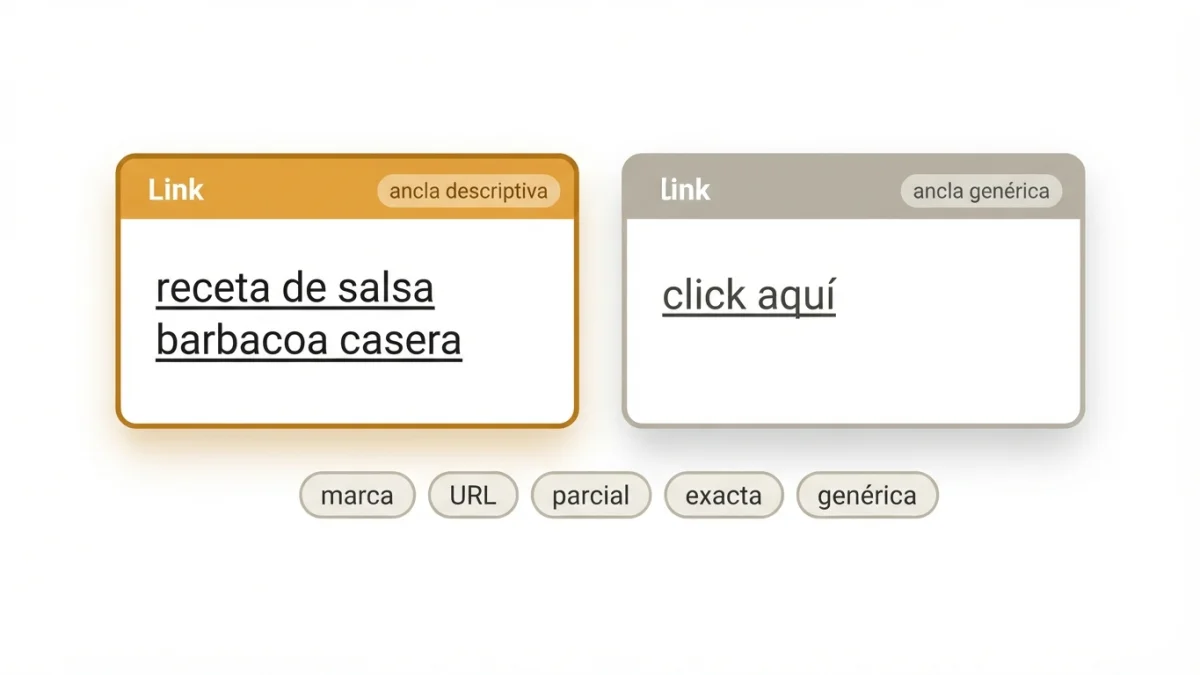
Table of contents
Anchor text is still a signal for Google, yet the exact-match myth makes it seem harder than it is. A guide to the official 2025-2026 rules: what anchor text is, its types, the spam policy, and what John Mueller recommended in 2026. Checklist included.
What Anchor Text Is and Why It Matters for SEO
Anchor text, also called link text, is the word or phrase you can click on in a link. Google's official documentation defines it as the visible text of a link: it tells people and the search engine something about the page it points to.
Definition With Examples: Descriptive Anchor vs "Click Here"
A cooking blog that links "homemade barbecue sauce recipe" toward its barbecue sauce article uses a descriptive anchor: anyone knows what they will find after clicking. If it repeated "click here" across forty articles pointing to different destinations, the text would say nothing, and Google would have to infer context from the surrounding words.
An Invention From Google's Founders: Anchor Text Since 1998
Anchor text is part of Google's DNA from its origins. The 1998 paper by Brin and Page already explained that anchors often describe pages better than the pages themselves, and that they allow indexing documents a text-based search engine cannot process. In the original crawl of 24 million pages, Google indexed 259 million anchors.
Anchor Text Types: From Exact Match to Bare URL
- Exact match anchor: the phrase matches the destination's main keyword, like "anchor text" toward an article about anchor text.
- Partial match anchor: it includes part of the keyword or a variation, such as "anchor text best practices".
- Branded anchor: it uses the brand or domain name, like "Clases SEO".
- Generic anchor: phrases with no descriptive value such as "click here", "read more", or "this link".
- Bare URL: the address itself, like https://clasesseo.com.
- Image anchor: when a link wraps an image, the alt text acts as the anchor.
There Is No Universal "Best" Type and No Official Percentages
The "ideal exact match percentage" tables circulating online do not come from Google: the company has never published a recommended distribution, and its spokespeople have called those percentages industry inventions. What does exist is the recommendation to use descriptive text and a spam policy that targets artificially optimized profiles. The healthy approach is to let anchors reflect how people link naturally.
Google's Official Rules (Current in 2026)
The "Link best practices for Google" guide, updated in December 2025, condenses the official position into four rules.
Rule 1: Descriptive, Reasonably Concise Anchor Text Relevant to Both Pages
Good anchor text is descriptive, reasonably concise, and relevant both to the page it is on and to the page it links to: it should describe the destination in a few words and make sense in its paragraph.
Rule 2: Avoid "Click Here", "Read More", and Links With Empty Text (Don't Use title as a Substitute)
Google cites "Click here" and "Read more" as examples of overly generic anchors. If the <a> element is empty, Google may use the title attribute as a fallback, but that is a technical fallback, not a recommendation: the visible text must exist and be descriptive on its own.
Rule 3: Image Links: the alt Text Is Your Anchor
When an image works as a link, Google uses its alt attribute as anchor text. A descriptive alt helps accessibility and SEO.
Rule 4: Anchors Inserted With JavaScript: Check the Rendered HTML With the URL Inspection Tool
If you insert anchor text with JavaScript, check with the URL Inspection tool that the link appears in the rendered HTML: Google can only reliably extract URLs from <a> elements with an href attribute. Our guide on Google Search Console explains how.
Exact Match Anchors and the Spam Policy: From Penguin to the Current Rule
The History: How Anchor Text Was Abused and Penguin Was Born (2012)
During the 2000s, buying hundreds of links with the exact keyword anchor was enough to inflate rankings. Google responded in April 2012 with Penguin, an algorithm to devalue artificially acquired links, which cited a high percentage of optimized anchors among its risk factors. Since 2016 Penguin lives integrated into the core algorithm: the current guidance is the spam policy.
The Current Spam Policy (May 2026): "Links With Optimized Anchor Text" as an Example of Link Spam
The spam policy, updated in May 2026, defines link spam as creating links to or from a site primarily to manipulate rankings, and it names anchor text explicitly: among its examples it includes paid advertorials with links using optimized anchor text in articles, guest posts, or press releases. A profile with many purchased exact match anchors is exactly that pattern.
What It Means in Practice: Natural Diversity, Not Percentage Engineering
The takeaway is not "avoid exact match anchors" but "avoid an artificially optimized profile". If your content is useful, it is normal to earn links with varied anchors: branded, copied titles, bare URLs. That natural mix is the healthy signal; percentage engineering simulates a profile you have not earned. Anchors are one more signal within your link profile, not the foundation of authority, as we explain in our article on topical authority.
Anchor Text in Internal Links: What You Control Most
Internal links are where you have full control over anchor text. If you need to review the link architecture between pages, our guide on internal linking covers that ground; here we focus on the visible text.
Mueller (2025): Repeating the Same Anchor in Navigation Doesn't "Dilute" Anything
The belief that repeating the same anchor "dilutes" its impact has no foundation in anything Google has said. John Mueller answered in April 2025 a case with four identical links to the same page: "having 4 identical links on a page to another page seems fine and common to me, I wouldn't worry about that". Google has also dampened sitewide links for years so they count as one.
Contextual vs Navigational Anchors: What Google Sets Aside
Google identifies the links that are part of the main content and sets aside those in menus or sidebars, an annotation Martin Splitt has explained publicly. Contextual anchors, those inside a paragraph, carry relatively more weight than navigation anchors.
Best Practices: Link With Words That Describe the Destination, Not "Here"
Choose the phrase in your own text that best describes the destination and turn it into the link. Instead of "learn more here", write "our guide on technical SEO explains how to do it". That improves navigation, accessibility, and the contextual signal.
Anchor Text in External Links: What You Can and Cannot Control
When You Write the Anchor vs When the Author Decides
In the links other sites point to you, the anchor is decided by the other site's author; you can influence it with your content and brand, but you cannot control the outcome. When you write links to other sites, you choose the anchor and the same rules apply. For earning links, see our guide on link building.
Branded Anchors and Bare URLs as the Natural Base of a Healthy Profile
A healthy profile is usually dominated by branded anchors and bare URLs, because that is how people link when a site is useful to them. That natural base leaves room for descriptive and partial anchors to appear organically. A profile made mostly of commercial exact match anchors would be a red flag.
What the Spam Policy Forbids: Buying Links and Optimized Anchors
The policy forbids buying or selling links that pass authority and includes sponsored articles with optimized anchors distributed on other sites. If you pay for a link, use rel="sponsored" or rel="nofollow". If a service offers you "optimized anchors" in a package, you are looking at the exact pattern the current policy describes as spam.
Mueller 2026: Visible Text Matters More Than title and aria-label
In February 2026, John Mueller answered on Bluesky whether aria-label could replace title to give search engines context: "I'd focus on the visible anchor text; make it obvious to everyone what the linked page is for". For SEO, the visible text is the signal that counts; for accessibility, it benefits everyone.
Checklist: Anchor Text Done Right in 6 Steps
- Describe the destination: words that indicate what the linked page contains.
- Stay concise: a few words.
- Avoid generic text: no "click here" or "read more" as the main anchor.
- Review linked images: make sure their
altdescribes the destination. - Verify rendering: if JavaScript generates the link, confirm with URL Inspection that it appears in the final HTML.
- Don't chase percentages: let anchors vary naturally between branded, URL, descriptive, and partial.
Anchor text is neither a magic lever nor a threat: it is a contextual signal Google values when it is descriptive, visible, and honest. The spam policy punishes building artificially optimized profiles, not using an exact match anchor once in a while. Apply the checklist and let natural diversity do the rest.