SEO-friendly URLs: how to structure your URLs and slugs in 2026
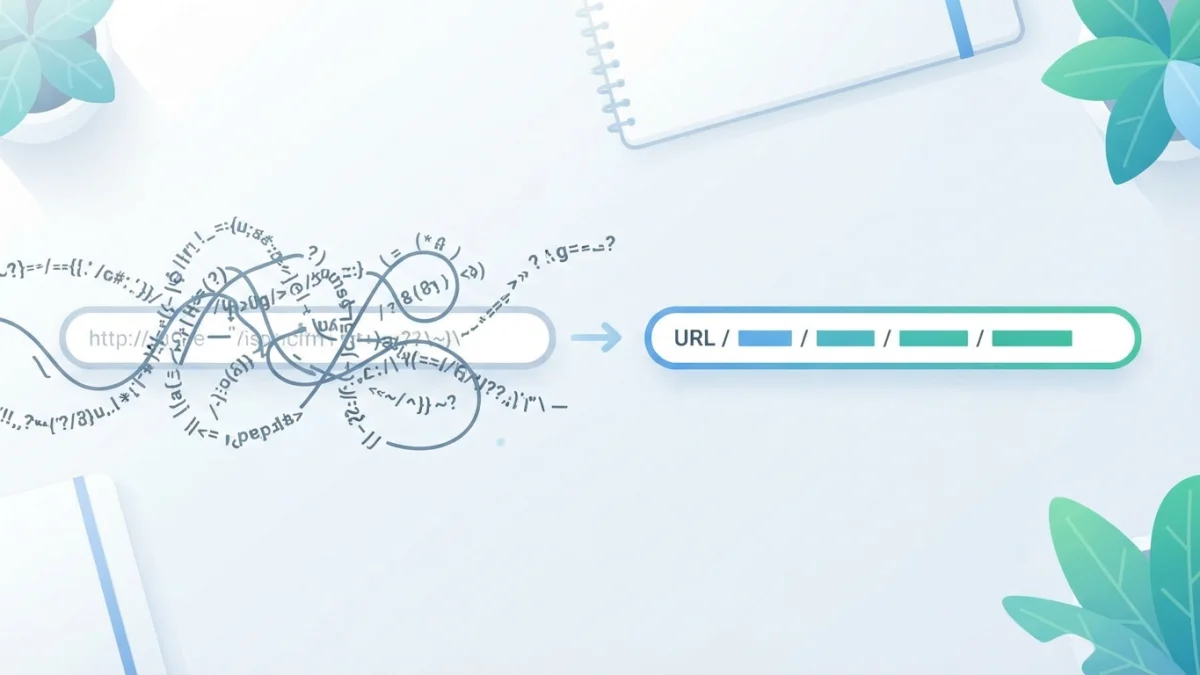
Table of contents
The URL is the first thing Google and your visitors see before entering your page. A well-structured URL improves CTR, makes crawling easier, and tells users what your page is about. Learn how to create SEO-friendly URLs and slugs with Google's official recommendations.
What is an SEO-friendly URL?
An SEO-friendly URL is a clear, descriptive, readable address that communicates what the page is about before anyone clicks. Compare these two addresses from the same store:
Bad:    store.com/product.php?id=4471&cat=3a5
Good:   store.com/running-shoes/nike-pegasus-40
The second one tells you exactly what you will find: running shoes from Nike's Pegasus 40 line. The first one forces you to guess. That difference shows up in three areas: CTR in search results (a readable URL invites the click), crawling efficiency (Google understands the hierarchy without wasting resources on parameters), and user experience (the address is easy to read, remember, and share).
To be honest about its weight: the direct impact of the URL on rankings is smaller than that of content or backlinks. But it is a quality and usability signal that reinforces everything else, and it is one of the few parts of your site you control completely.
URL, path, and slug: the parts you control
A URL has several parts: the protocol (https://), the domain (store.com), the path (/running-shoes/), the slug (the final part, nike-pegasus-40), and optionally parameters (?color=blue) and anchors (#reviews).
The domain is already decided, but the path and especially the slug are up to you. The slug is where you win or lose: it is the part Google shows in results, the part people share on social media, and the part that sticks in memory. That is why the rest of this guide focuses on how to write it well.
What Google recommends (current guidance, updated Dec 2025)
The official URL structure best practices guide from Google Search Central was updated in December 2025 and remains the canonical reference. These are its recommendations, with practical examples.
Use readable words, not ID numbers
Google says it with its own example: it prefers https://example.com/vegetables/leafy-greens/spinach over https://example.com/index.php?topic=42&area=3a5. Numeric identifiers say nothing to the user or the search engine; words do.
Use your audience's language
The words in the URL should be in the user's language, not in internal codes. If your audience speaks Spanish, the path goes in Spanish. For non-Latin characters, Google recommends using the transliterated form (for example, /recipes/spanish-omelette/ instead of uncoded special characters).
Use hyphens, not underscores
Google is explicit: the hyphen (-) helps users and search engines identify separate concepts, while the underscore (_) is historically used to join words as if they were one (think of variable names like format_date). A URL with underscores (/my_seo_guide) presents Google with a single glued word; with hyphens (/my-seo-guide) it presents three clear words.
Keep URLs lowercase (URLs are case sensitive)
For Google, /APPLE and /apple are different URLs. If your server serves both, you create accidental duplicates that split signals between two addresses. The rule is simple: always use lowercase, and if your CMS allows uppercase, configure a redirect to normalize them.
Use few parameters and encode them properly
Use = for key-value pairs (?color=blue), & to add parameters (?color=blue&size=42), and commas for multiple values. Avoid using fragments (#) to change page content: that is the job of the History API, not the URL. Non-ASCII characters should use percent-encoding.
Follow IETF STD 66
URLs should comply with the IETF standard (STD 66, RFC 3986). In practice this means: reserved characters only with their correct meaning, percent-encoding for everything else, and no stray odd characters that break copy and paste.
Is the keyword in the URL a ranking factor?
In 2016, John Mueller of Google said in a Webmaster Central hangout that the keyword in the URL was "a very small ranking factor", something he "wouldn't really try to force". The statement is still quoted because it remains the official position: it is covered by both Search Engine Journal and Search Engine Roundtable.
The honest conclusion: including the keyword once in the URL adds very little ranking value. Do not restructure a site just to put keywords in URLs. What really matters is that the URL is readable, descriptive, and consistent. If the keyword appears naturally, great; if not, do not force it.
Best practices for writing slugs
These are the rules that apply in practice to most sites:
- Short and descriptive. Backlinko's study of 11.8 million search results found a correlation between shorter URLs and better rankings. It is correlation, not causation, but it reinforces what common sense already says: the less noise, the better.
- Main keyword once. Repeating it is keyword stuffing and it looks bad:
/shoes-shoes-deals-shoesfools nobody. - No dates. A URL with a year (
/seo-guide-2024) ages and forces you to change it or keep a URL that no longer tells the truth. - No stopwords or filler.
/how-to-create-a-seo-friendly-url-in-an-easy-and-quick-wayweighs too much;/seo-friendly-urlssays the same in three words. - Stable. Set the slug when you publish and never touch it. A live URL accumulates links, bookmarks, and history; every change requires a redirect and loses part of the accumulated value.
URL structure by site type
Blogs and content
For evergreen content, avoid dates in the URL: /blog/my-seo-guide ages better than /blog/2026/09/my-seo-guide. A simple category + slug hierarchy (/technical-seo/friendly-urls) helps Google understand the structure and users find their way. The flatter the hierarchy, the better: each level adds crawl depth.
E-commerce
In online stores, clean category/product paths (/running-shoes/nike-pegasus-40) are the standard. The danger is faceted navigation: additive filters (?color=blue&size=42&sort=price) multiply URLs and can cause a crawl explosion. Sorting and filter parameters that do not change the content should be blocked (robots.txt or canonical) or consolidated so Google does not crawl thousands of useless combinations.
Multilingual sites
For multilingual sites, subdirectories with language codes (/es/, /en/) are the simplest option and the easiest to maintain. The alternatives (ccTLDs like .cl or .es, or subdomains like es.store.com) make sense in specific contexts but add complexity. For language signals and hreflang tags, see our full guide on how to build a multilingual website.
URL parameters: when to use them and when to avoid them
Not all parameters are equal. Those that change page content (?category=shoes) are part of the structure and must be treated as real URLs. Those that change nothing visible (tracking, session, referrer) are noise for Google.
Google's documentation mentions concrete examples to avoid: session IDs in the URL (use cookies), irrelevant parameters that multiply URLs without adding value, and dynamic calendars that generate infinite URLs (?date=2026-09-01, ?date=2026-09-02...). The fix has three fronts: block problematic URLs with robots.txt, consolidate variants with the canonical tag and duplicate content handling, and simplify the structure so the problem does not exist.
Common URL mistakes and how to fix them
- IDs and unreadable strings.
product.php?id=4471says nothing. Fix it with a descriptive slug. - Underscores.
my_seo_guideglues words together. Switch tomy-seo-guide. - Uppercase.
/Products/Nikecreates duplicates. Normalize to lowercase. - Dates.
/guide-2024ages. Remove the year from the slug. - Keyword stuffing.
/shoes-shoes-deals-shoesrepels. One term only. - Endless URLs. More than 60-70 characters get truncated in results. Trim them.
- Changing URLs without redirects. Every old URL that dies without notice loses its value. Always implement 301 redirects before moving anything.
- Broken relative links. A badly written href generates ghost URLs that Google discovers and crawls for nothing. Validate your HTML regularly.
Checklist: audit and fix your URLs today
You can apply all of the above this very week with these six steps:
- Audit. Crawl your site with a tool like Screaming Frog or check the pages report in Google Search Console.
- List the problems. Note URLs with parameters, uppercase, IDs, or long slugs.
- Design the new slug. Short, lowercase, hyphenated, keyword once.
- Implement 301 redirects. From the old URL to the new one, no exceptions.
- Update internal links. Point them straight to the new URL, not through the redirect.
- Verify. Use URL inspection in Search Console and monitor traffic and rankings for the following weeks after the change.
URLs are not the most important SEO factor, but they are the front door to your content. Structuring them well is one of the cheapest and most durable investments you can make: you do it once, forget about it, and it keeps working for years. If you also pair them with a solid internal linking structure and clean redirects when you change something, your site will thank you in the short and long term.